When we talk about Intelligence, more specifically human intelligence, this is an interesting subject to discuss; it involves (Sternberg, 2000):
the human brain, which is the most complex organ in the human body;
the mind, which is related to the ability to think, reason, remember, understand, and feel;
logical thinking, which is the ability to reason and solve problems;
comprehension, associated with the ability to understand and interpret information;
applicability, which relates to the ability to apply knowledge and skills, mostly in practical situations;
Artificial Intelligence
Regardless of whether we are math geniuses or charismatic salespeople, we use cognitive skills such as memory, attention, pattern recognition, and other abilities to understand and succeed in the world every day.
In general, intelligence can be well defined as an individual’s ability to perform tasks effectively using their own knowledge, interpretation, and insight.
The level of intelligence varies from person to person in terms of how they perceive and perform actions.
Artificial Intelligence
The concept of AI has been around since the 1940s (Newell, 1982);
The first computing method based on “intelligence” was attributed to the mathematician Alan Turing in 1947. Scientists at the time stated that further discoveries about machine intelligence could be obtained using computer programs and simulation;
Artificial Intelligence
During the 1950s, Turing also discussed the circumstances for considering a machine as intelligent as a human. He strongly opined that any machine could be capable of imitating and pretending to be a human being to another human, without leaving any doubt, and thus be considered intelligent.
This concept of testing machine intelligence, introduced by Alan Turing, is known as the Turing Test.
Any machine that successfully completes the Turing Test can be considered intelligent, but an extraordinarily intelligent machine can always imitate humans even without knowing much about them.
Artificial Intelligence
What is the Turing Test?
Turing proposed his concept through the game called the “party test”, also known as the “imitation game”
The basic concept of this game is to find out whether the participant is a human or a computer.
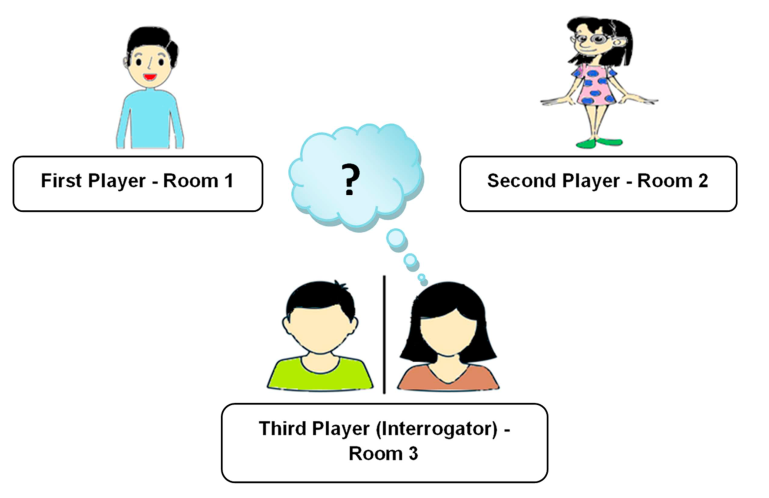
Scenario 1 of the test consists of three players, where the first player is a “man”, the second player is a “woman” and the third player is the “interrogator”, who can be either a man or a woman. The first two players will be in different rooms, and the interrogator does not know who the players are. Now, the challenge for the interrogator is to discover the gender of the first two players based on the written answers given by them to the questions asked by the interrogator. Another challenge will be created by having the first player intentionally give incorrect answers to the questions, which may mislead the interrogator into inferring that the first player is a “woman” instead of a “man”. Figure 2 shows the scenario of the imitation game.
Figure 1: Scenario 1 in the Turing Test.
Artificial Intelligence
What is the Turing Test?
Turing proposed his concept through a game called the “party test”, also known as the “imitation test”.
The basic concept of this game is to find out whether the participant is a human or a computer.
Scenario 1 of the test consists of three players, where the first player is a “man”, the second player is a “woman”, and the third player is the “interrogator”, who can be either a man or a woman. The first two players are in different rooms, and the interrogator does not know who the players are. Now, the interrogator’s challenge is to discover the gender of the first two players based on the written answers they provide to the questions asked by the interrogator. Another challenge is created by having the first player intentionally give incorrect answers to the questions, which may lead the interrogator to infer that the first player is a “woman” instead of a “man”. Figure 2 shows the imitation test scenario.
Figure 2: Scenario 1 in the Turing Test.
Artificial Intelligence
What is the Turing Test?
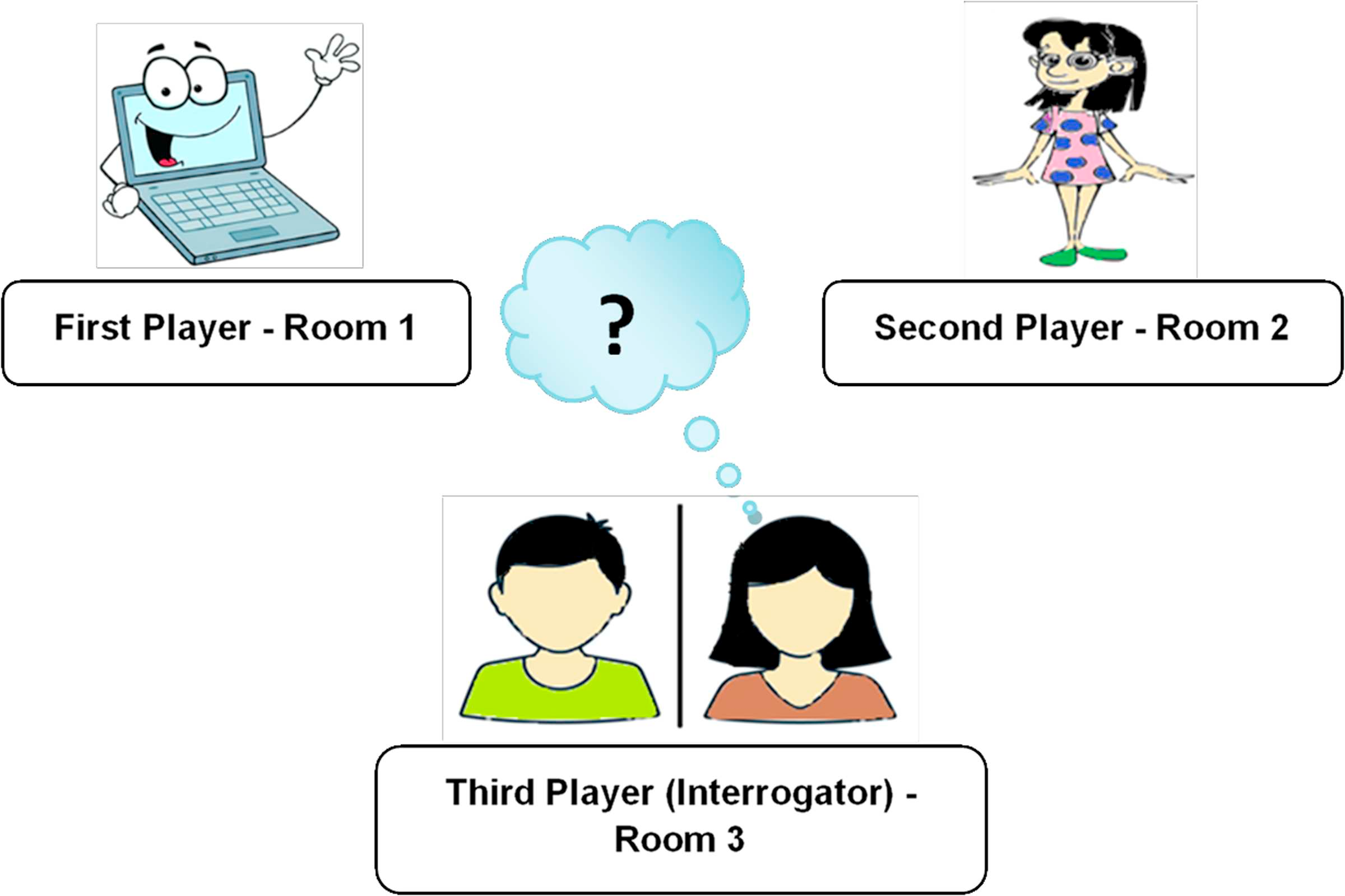
Turing attempted to design this game with a slight modification, in which he replaced one of the first two players with a computer in test scenario 2.
He analyzed whether the machine had the capacity to act as a human player by applying its own intelligence.
He proved through the test that the computer has a better capacity to confuse the interrogator with its intelligence, such that the interrogator might misinterpret the first player as human instead of a computer.
Machine intelligence was proven through Alan Turing’s test and was widely accepted by the research community at the time.
Figure 3: Scenario 2 in the Turing Test.
Artificial Intelligence
However, the term “Artificial Intelligence” was effectively coined by John McCarthy in 1956, at a conference at Dartmouth College, marking the beginning of a new era in AI research studies (McCorduck and Cfe, 2004).
And with this new term and field of research, the objectives were/are focused on the mission of using computers and science to study and reproduce the intelligence and decision-making skills associated with a human being.
Thus, the use of AI is to investigate the feasibility of machines simulating aspects of the human intellect through computational models and algorithms, which were driven by the work of researchers such as Turing, Shannon, McCarthy, Minsky, among others.
Artificial Intelligence
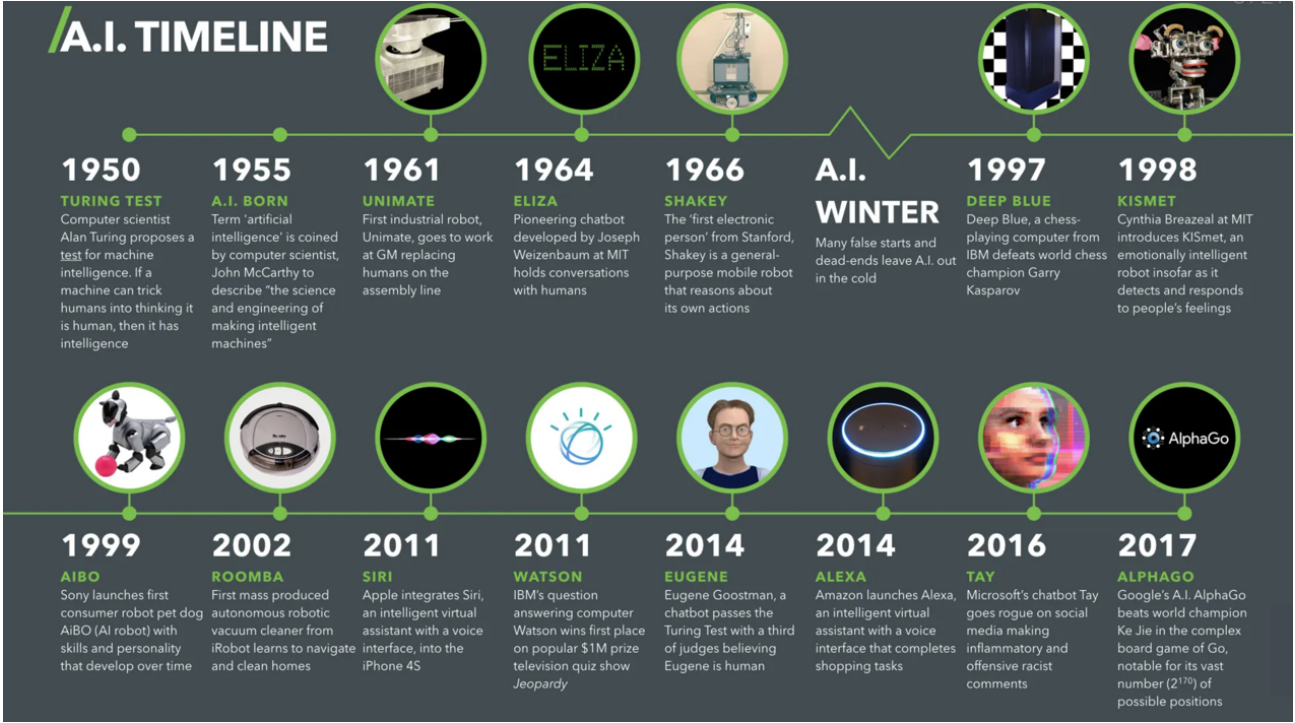
Timeline 1 da IA.(fonte:Weijermars, et.al. )
Artificial Intelligence
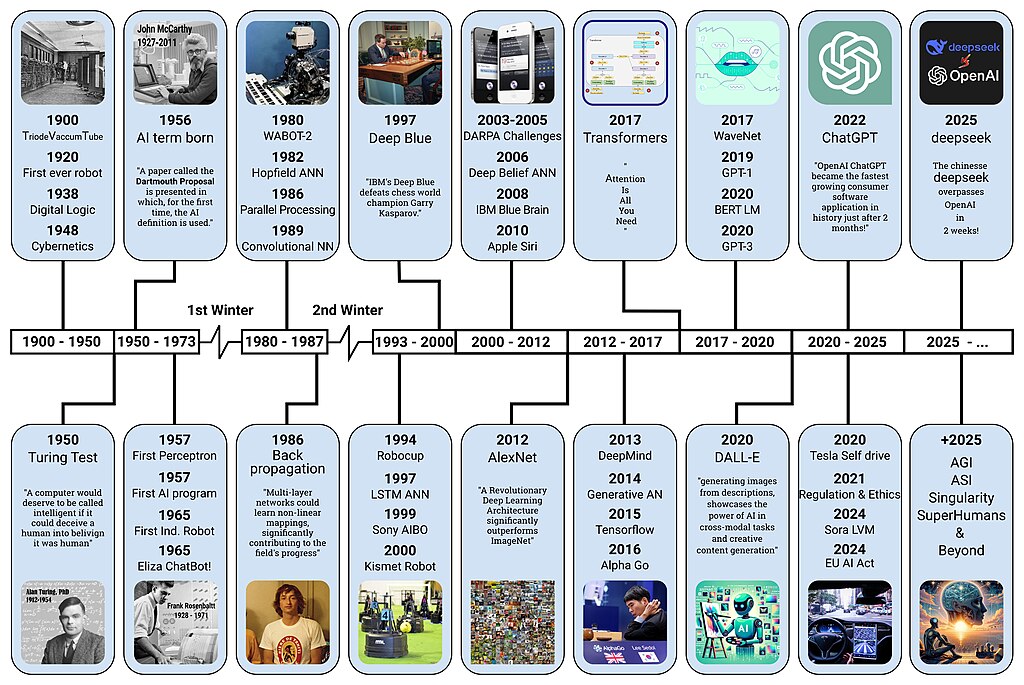
Timeline 2 da IA.(fonte:https://commons.wikimedia.org/wiki/File:AI-History-Timeline-300dpi.jpg)
GPT-5.2 – Multimodal model by OpenAI (USA) with advanced reasoning capabilities, autonomous agents, and strong performance in coding, data analysis, and professional tasks.
Claude Opus / Sonnet 4.6 – Language models by Anthropic (USA) known for strong performance in coding, structured reasoning, and enterprise applications.
Gemini 3.1 (Pro / Flash) – Family of multimodal models by Google DeepMind (USA/UK) featuring large context windows, native multimodality, and strong performance in mathematics and science.
Grok 4 – Model by xAI (USA, Elon Musk), integrated with X (Twitter), focused on reasoning, real-time information access, and conversational AI.
Llama 4 (Scout / Maverick) – Models by Meta (USA) based on Mixture-of-Experts architectures, widely used in open-weight ecosystems and enterprise applications.
Mistral Large 3 – Model by Mistral AI (France), known for computational efficiency and deployment in enterprise and self-hosted environments.
Sora – Hyper-realistic video generation model by OpenAI, capable of generating complex dynamic scenes from text prompts.
Perplexity AI – AI-powered search system combining large language models with real-time web access and verifiable citations.
Chinese:
DeepSeek-R1 / DeepSeek-V3 – Models by DeepSeek, recognized for strong performance in mathematics, reasoning, and coding, including high-performance open-source versions.
Qwen 2.5 / Qwen-Max – Model family by Alibaba Cloud, notable for multilingual capabilities and integration with enterprise cloud services.
Kimi K2 – Model by Moonshot AI, based on a Mixture-of-Experts architecture and focused on agent-based AI, reasoning, and coding tasks.
MiniMax M2 – Multimodal model designed for large-scale commercial AI applications and autonomous agent systems.
Others (Japanese and Diverse):
Stable Diffusion 3 / Stable Video – Generative models by Stability AI for image, video, and multimedia content generation.
Nemotron-3 – Model by NVIDIA, designed for industrial AI applications and custom LLM training.
Genie (World Models) – Research project by Google DeepMind focused on generating interactive virtual environments and simulated worlds from prompts.
SORA 2 é um modelo de IA desenvolvido pela OpenAI que pode transformar texto em vídeo. O modelo é capaz de criar vídeos de alta qualidade a partir de descrições de texto.
There are three approaches to Artificial Intelligence:
Behaviorism
is a school of thought that states that intelligence depends on perception and action. Thus, intelligent behavior can only be demonstrated in the real world through constant interaction with the environment.
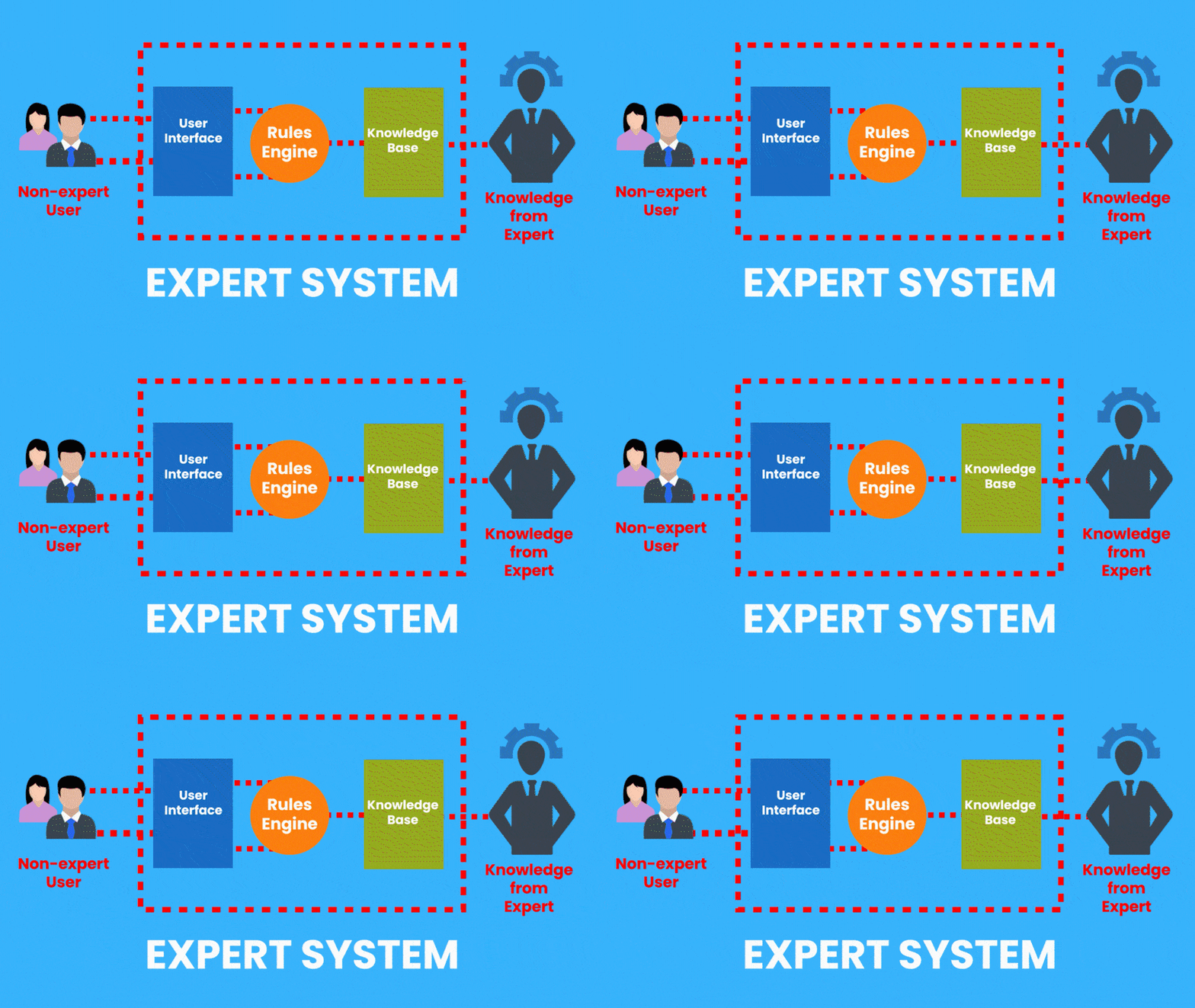
Symbolic AI
attempts to replicate human intelligence, such as the ability to solve problems through rules and logic. Through symbols, such as words and concepts, a logical structure is organized that allows the AI system to perform tasks.
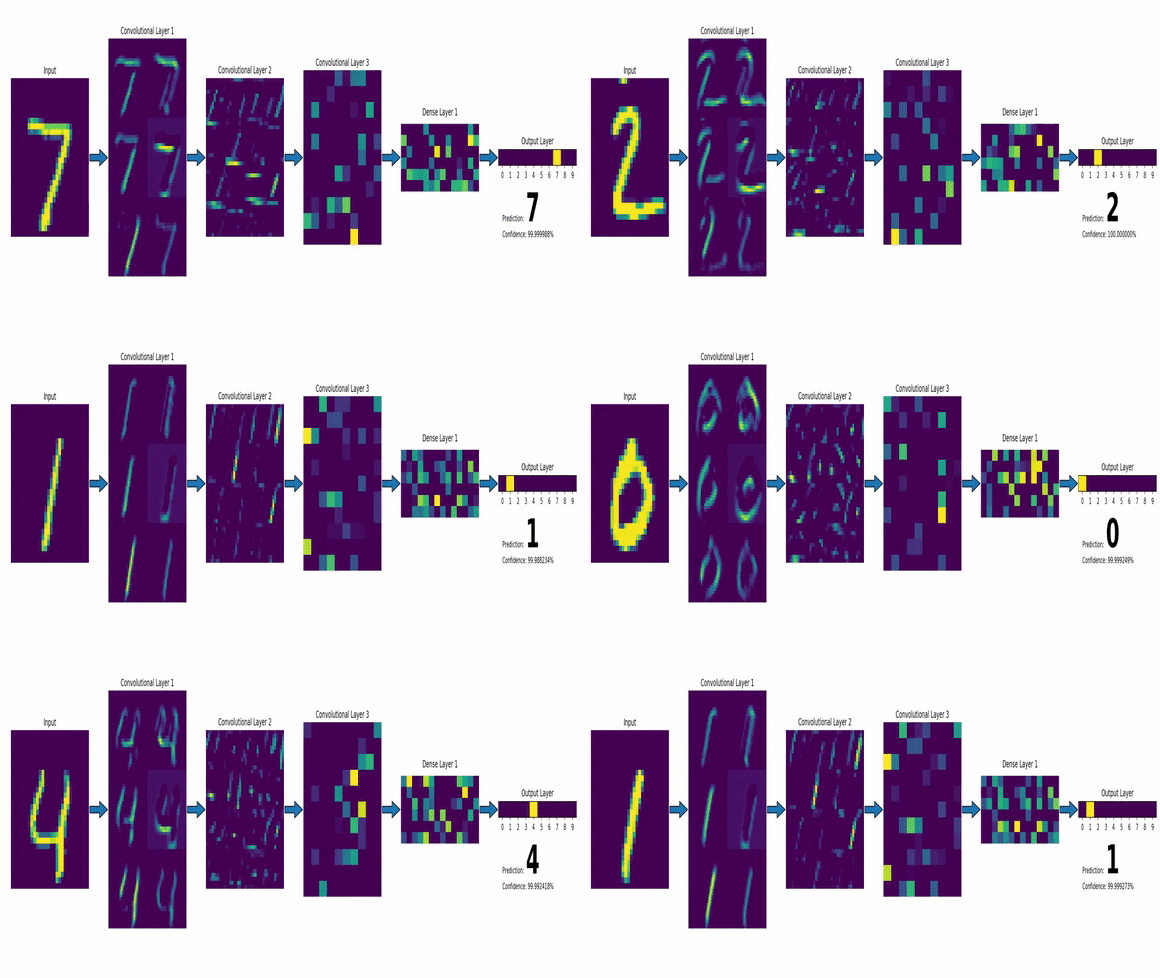
Connectionist AI
is based on the simulation of brain components (modeling human intelligence), such as neurons and synapses. Here, solutions are based on patterns and machine learning, attempting to mimic the functioning of the human brain.
Artificial Intelligence
Example of Behaviorism: Reinforcement Learning
Example of Symbolic AI: Expert Systems
Example of Connectionist AI: Neural Networks - CNN
Artificial Intelligence
Artificial Intelligence is divided into two parts:
General Artificial Intelligence or Strong AI
is when a machine truly understands what is happening. Emotions and creativity may exist. For the most part, it is what we see in science fiction movies.
Weak AI
is when a machine performs pattern matching and is related to specific tasks, and the capabilities are not easily transferable to other systems.
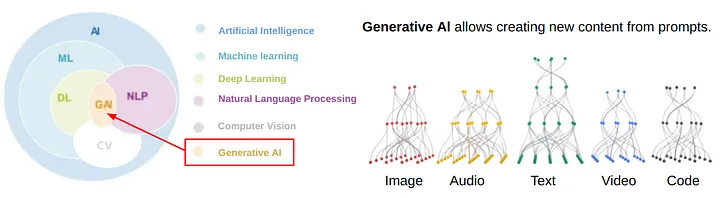
Artificial Intelligence
Artificial Intelligence
Machine Learning
Deep Learning
Gen AI
Inteligência Artificial
Artificial Intelligence
Machine Learning
Deep Learning
Gen AI
AI Environment
The artificial intelligence environment consists of five main components:
Machine: it is a basic and implicit component in both non-AI-based and AI-based environments;
Human Intelligence: this component is essential for incorporating ‘intelligence’ into the machine, so that it acts as an intelligent machine carrying human intelligence in the form of a list of instructions, also called programs, software, or coding;
Internet of Things (IoT): Currently, the Internet of Things (IoT) has a very close relationship with the AI environment, since most current decision-making depends on data produced in real-time by humans and machines;
Machine Learning (ML) Algorithms: Machine learning algorithms play an important role in AI. These algorithms are very useful in predicting events based on available data. Among the types of learning are supervised (Regression, Classification), unsupervised (clustering methods, dimensionality reduction), among others.
AI Environment
The artificial intelligence environment consists of five main components:
Machine: it is a basic and implicit component in both non-AI-based and AI-based environments;
Human Intelligence: this component is essential for incorporating ‘intelligence’ into the machine, so that it acts as an intelligent machine carrying human intelligence in the form of a list of instructions, also called programs, software, or coding;
Internet of Things (IoT): Currently, the Internet of Things (IoT) has a very close relationship with the AI environment, since most current decision-making depends on data produced in real-time by humans and machines;
Machine Learning (ML) Algorithms: Machine learning algorithms play an important role in AI. These algorithms are very useful in predicting events based on available data. Among the types of learning are supervised (Regression, Classification), unsupervised (clustering methods, dimensionality reduction), among others.
Machine Learning
Statistical Machine Learning (ML) or Machine Learning (ML) is a subfield of Artificial Intelligence that studies, develops, and analyzes learning algorithms. Through the use of ML methods, data-driven models can be created to solve a specific type of AI problem, including supervised, unsupervised, and reinforcement learning.
Machine Learning
Initially, the applications considered as ML were only those developed strictly by the computing community; however, in the late 90s, ML applications began to overlap with those of statistics.
Currently, the ML community is quite interdisciplinary, with statistics being one of its core areas. While until the 90s, methods created by statistics were beginning to be incorporated into ML, nowadays the opposite direction is increasingly common: methods developed by ML have started to be used in statistics.
Thus, most current algorithms in Machine Learning and Artificial Intelligence are based on concepts from Statistics and Computing.
Why are AI and ML desired in companies?
Among the various reasons and advantages of applying artificial intelligence are increased efficiency, the possibility of automating processes, and, consequently, an increase in the speed of task completion.
Applications that utilize artificial intelligence are capable of reducing errors and increasing productivity. Therefore, companies that adopt the technology can easily eliminate various operational costs.
Why are AI and ML desired in companies?
In early 2020, an online McKinsey survey conducted with 2,360 executives worldwide already showed the impact of using artificial intelligence in business. According to the study, 63% of executives whose companies adopted AI reported that the resource increased revenue in the business areas where it is applied, and 44% say it reduced the company’s costs. Revenue increases are most frequently reported in marketing and sales, and cost decreases in manufacturing1.
Why are AI and ML desired in companies?
However, artificial intelligence is still a robust technology that requires companies to overcome certain challenges to achieve positive results with it.
The following details 5 of these challenges:
1. Data issues
The biggest obstacles to launching an AI project are the data. More specifically, the lack of useful and relevant data, free of embedded biases, and that do not violate privacy rights.
Why are AI and ML desired in companies?
2. Tooling and development costs
Every investment must be carefully considered before starting the implementation process and, obviously, it is no different with AI. It is necessary to list what this technology can do for your business and clearly visualize how artificial intelligence will be used and how it will perform. For those building AI systems from scratch, labor and technology costs can be high. This is especially the case for those who are just starting out.
Why are AI and ML desired in companies?
3. Implementation challenges - and skills shortage
AI implementations bring several technical challenges, and most organizations do not have sufficient AI skills to handle them efficiently. If the company lacks the necessary technical skills to incorporate AI into its business and the required investment is too high, one solution is to consider working with a partner company so that you have greater control and autonomy in the process.
Why are AI and ML desired in companies?
4. Business process challenges
Integrating AI into a company’s functions is another obstacle. In a digital transformation process, organizational culture is one of the main challenges. Furthermore, having the proper hardware and software infrastructure also requires significant investment and must be done in a very well-planned manner.
Why are AI and ML desired in companies?
5. Ethical and legal use of artificial intelligence
Privacy is one of the issues that companies using new technologies will have to navigate. With personal data protection laws already in effect and being debated by governments in various countries around the world, companies must have the maturity to comply with legal requirements in their operations and treat stored information ethically.
… to finish - reflection
More and more, we are living in the age of algorithms, in which decisions that affect our lives are being made by mathematical models. Thus, it is important for scientists to keep in mind that these models should, in theory, lead us toward a fairer world, where everyone is judged by the same rules and prejudice is eliminated.
This issue is addressed in the book “Weapons of Math Destruction”, in which the author presents several models that create a discriminatory spiral; for example, a poor student cannot obtain a loan because the mathematical model considers him too risky (due to the address where he lives), and he is also rejected by the university that could pull him out of poverty.
An Introduction to Statistical Learning: with Applications in R, James, G., Witten, D., Hastie, T. and Tibshirani, R., Springer, 2013, link: https://www.statlearning.com/.
Mathematics for Machine Learning, Deisenroth, M. P., Faisal. A. F., Ong, C. S., Cambridge University Press, 2020, link: https://mml-book.com.
References
Complementary
An Introduction to Statistical Learning: with Applications in python, James, G., Witten, D., Hastie, T. and Tibshirani, R., Taylor, J., Springer, 2023, link: https://www.statlearning.com/.
Matrix Calculus (for Machine Learning and Beyond), Paige Bright, Alan Edelman, Steven G. Johnson, 2025, link: https://arxiv.org/abs/2501.14787.